Morgan Kotter9 min read
Capitol Reef National Park has one developed campground and two primitive ones. Fruita Campground holds 71 sites and is reserved through recreation.gov. The two primitive campgrounds — Cathedral Valley and Cedar Mesa — are free, first-come, first-served, and require driving unpaved roads. Backcountry camping needs a permit, which is also free. The Park Service states that Fruita often fills daily spring through fall, and points visitors to camping alternatives within an hour's drive when it does.
Camping is the default way people stay at Capitol Reef, and Fruita is genuinely one of the better national park campgrounds in the system — an irrigated green orchard in the middle of red desert, with deer wandering through it at dusk. It is also small, and demand has long since outgrown it.
The Three Campgrounds
Camping inside the park
- Fruita Campground71 sites · developed · recreation.gov
- Cathedral ValleyPrimitive · free · first-come
- Cedar MesaPrimitive · free · first-come
- BackcountryFree permit required
That is the entire inventory. There is no lodge inside Capitol Reef and no other developed camping, which is why the campground question matters more here than at parks with more built infrastructure.
Fruita Campground
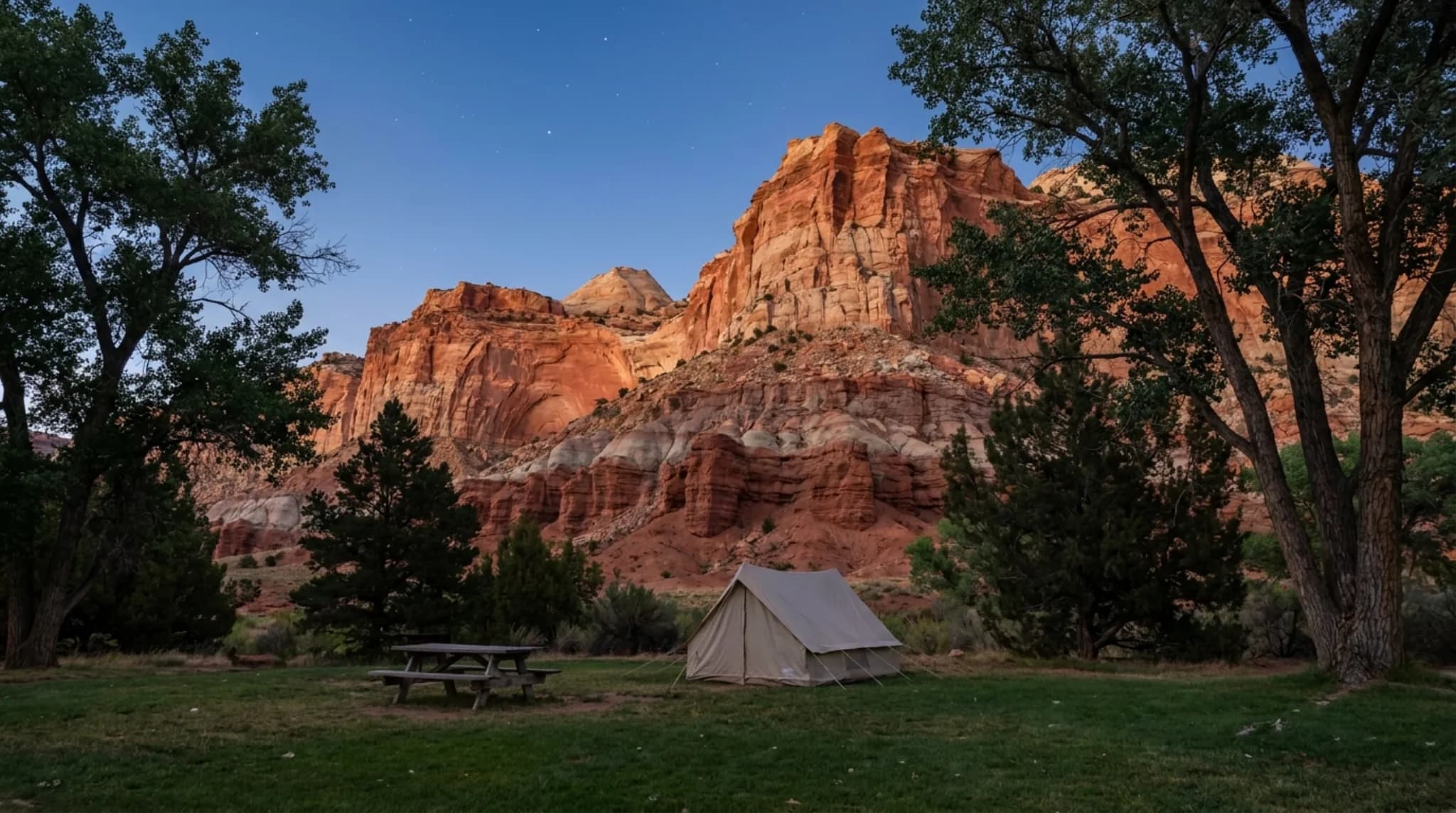
Fruita sits in the historic district in the middle of the park, among the orchards planted by the Mormon settlers who farmed this stretch of the Fremont River. It is the only developed campground in Capitol Reef, and the Park Service handles all reservations through recreation.gov.
There is also a Group Campsite within Fruita for larger parties, reserved separately from the individual sites.
The setting is the reason it fills. Irrigated grass and mature fruit trees in the middle of a desert park is an unusual thing to sleep in, and the orchards are open for seasonal picking as each crop ripens. Deer move through the campground at dawn and dusk with almost no concern for the people in it.
The Primitive Campgrounds
The Park Service describes two free primitive campgrounds in more remote parts of the park. They are Cathedral Valley in the north and Cedar Mesa in the south, and they are a genuinely different proposition from Fruita.
Cathedral Valley
In the park's northern district, among the free-standing monoliths the valley is named for. Reached by unpaved roads that include a river ford — conditions determine whether it is passable, and they change.
Cedar Mesa
In the southern Waterpocket district, off the Notom-Bullfrog Road. Long, remote, and with a view east to the Henry Mountains.
Free, both of them
No fee and no reservations. First-come, first-served, which in practice means they are far more available than Fruita but far less certain.
Primitive means primitive
Expect no drinking water and no hookups. Carry everything in, including all your water, and carry everything out.
Backcountry Camping
If you want to sleep away from a road entirely, the Park Service requires a free backpacking permit before you start an overnight trip. Permits are arranged at the visitor center.
Free permits are a deliberate design: they cost nothing so that nobody is tempted to skip them, which means the park knows who is out and where. Capitol Reef is largely undeveloped away from SR-24 and the Scenic Drive, and that is precisely the country where an unrecorded trip becomes a search.
Canyoneering and rock climbing permits at Capitol Reef are also free, and are handled the same way.
When Fruita Is Full
This is the situation most people are actually researching, and the Park Service addresses it directly — it notes that camping alternatives exist within an hour's drive of the visitor center.
An hour's drive covers three quite different options:
West — Torrey and Teasdale
The gateway towns, 11 to 20 minutes out. This is where the commercial lodging and private campgrounds are concentrated, and where you will find anything with a shower.
Up — Boulder Mountain
Dixie National Forest campgrounds on the Aquarius Plateau, above Teasdale. Several thousand feet higher, which makes them a genuine relief in midsummer and closed in winter.
East — BLM land
Dispersed camping on public land toward Caineville and Factory Butte. Free and empty, with no facilities whatsoever and shale roads that turn impassable when wet.
The west option is the one most people want and the one that gets least researched, because the park's own materials reasonably stop at the park boundary. Torrey and Teasdale sit at around 6,800 and 7,000 feet respectively, which means nights stay cool even in July — the same reason the mountain campgrounds work, without the drive.
If that is the direction you end up going, where to stay near Capitol Reef covers what actually exists in the two gateway towns and how they differ.
What the Park Does Not Publish
Worth being explicit, because a lot of pages on this topic state numbers with more confidence than the source supports.
The National Park Service publishes the site count for Fruita, the existence of the group site, the fact that the two primitive campgrounds are free, and the fact that backpacking permits are free. It routes fees, reservation windows and live availability for Fruita to recreation.gov rather than restating them, and it directs seasonal and road-condition questions to the phone line.
So: for the current nightly rate and how far ahead the booking window opens, recreation.gov is the authority. For whether the road to Cathedral Valley is passable this week, 435-425-3791 is. Any page quoting you a fixed figure for either is repeating something that was true in some past season.
Seasons, and What They Change
Spring and autumn
The busiest and the best. Fruita fills daily. Autumn adds the orchard harvest and lower crowds than spring in most weeks.
Summer
Hot at park elevation and the thunderstorm season. Flash flooding is the real hazard — the dirt spur roads and the washes are where it matters, not the pavement.
Winter
Quiet, cold, and the campgrounds stay accessible. Some roads inside the park close for snow and weather. Services in the gateway towns thin out considerably, so confirm rather than assume.
Any season, after dark
Cold nights year-round at this elevation. A sleeping bag rated for the season you think you are in is usually one season short here.
Frequently Asked Questions
How many campgrounds are in Capitol Reef National Park? Three. The National Park Service describes one developed campground and two primitive campgrounds. Fruita Campground is the developed one, with 71 sites. The two primitive campgrounds are free and sit in more remote parts of the park.
How many sites does Fruita Campground have? 71. The Park Service describes it as the only developed campground in Capitol Reef, and reservations are handled through recreation.gov.
How do you reserve a site at Fruita Campground? Through recreation.gov. The Park Service directs all Fruita reservations there rather than taking them at the park, so recreation.gov is where the current fee, the booking window and live availability are shown.
Does Fruita Campground fill up? Yes. The National Park Service states plainly that Fruita Campground often fills daily spring through fall. Arriving without a reservation in that window is a gamble rather than a plan.
Are the primitive campgrounds at Capitol Reef free? Yes. The Park Service describes two free primitive campgrounds in more remote parts of the park — Cathedral Valley to the north and Cedar Mesa to the south. Both are first-come, first-served, and reaching them involves unpaved roads.
Do you need a permit to backpack in Capitol Reef? Yes, and it is free. The Park Service requires a free backpacking permit before starting an overnight trip. Permits are arranged at the visitor center.
Can you camp outside the park near Capitol Reef? Yes. The Park Service itself notes that camping alternatives exist within an hour's drive of the visitor center, which covers the Torrey and Teasdale area to the west, national forest land up on Boulder Mountain, and BLM land to the east.
Is there a group campsite at Capitol Reef? Yes. There is a reservable Group Campsite within Fruita Campground for larger parties. It is booked separately from the individual sites.
Campground counts, fee status and permit requirements are as published by the National Park Service for Capitol Reef National Park. Current rates, reservation windows and availability are on recreation.gov; road and seasonal conditions are on the park information line, 435-425-3791.